WPM

28 August, 2020

EMBEDDED Qs🤨❔

I made this short video about the topic (fun fact: i love PowerPoint) Select HD!                   


5 RULES FOR EMBEDDED QUESTIONS

Rule One
If the embedded question is part of a statement, use a period and not a question mark at the end of the sentence. Also, if the question is in the present or past simple verb tense, omit the auxiliary verbs do, does, and did and change the verb to its appropriate form, as in the example below.

Direct Question: What time did he leave
Embedded Question: I wonder what time he left.


Rule Two
If the embedded question includes an auxiliary verb or the verb "to be", reverse the positions of the subject and the auxiliary verb, as in the examples below.

Direct Question: What did he say?
Embedded Question: Could you tell me what he said?

Direct Question: Can you help me?
Embedded Question: I wonder if you could help me.

Direct Question: Is he a doctor?
Embedded Question: Do you know if he is a doctor?

Rule Three
Do not use a verbal contraction at the end of the sentence.

Direct Question: Where is she?
Correct Embedded: Question Do you know where he is?
Incorrect Embedded: Question Do you know where he's?

Rule Four
Embedded questions are introduced by whether, whether or not, and if when there is no question word in the sentence (yes/no questions).

Direct Yes/No Question: Will he be there?
Embedded Question: Do you know if he will be there?
                                   Do you know whether or not he will be there?
                                   Do you know whether he will be there or not?


Rule Five
The infinitive can follow a question word or whether in embedded questions, as in the following example.

Direct Question: What should I do?
Embedded Question: Please tell me what I should do.
Embedded Question with an Infinitive: Please tell me what to do.



27 August, 2020

NOUN CLAUSES🤠

A noun clause is a group of words acting together as a noun. These clauses are always dependent clauses (they do not form a complete sentence).

How to spot a noun clause? Look for these words (conjunctions)

⛭How, That, What, Whatever, When, Where, Whether, Which, Whichever, Who, Whoever, Whom, Whomever, Why

Example:
  • I know that it happened.
  • I know how it happened.
  • I know why it happened.


Noun clauses act as different parts within a sentence! 
As subjects, direct objects, objects of the preposition, and predicate nouns.


NOUN CLAUSES AS SUBJECTS

Pizza is fine with me.
Whatever they want is fine with me.

NOUN CLAUSES AS DIRECT OBJECTS

Can you tell me the place?
Can you tell where it is the place for lunch?

NOUN CLAUSES AS OBJECTS OF THE PREPOSITION

I asked about Elise.
I askes about why Elise hate those boys.

NOUN CLAUSES AS PREDICATE NOUNS

Happiness is a cold beer.
Happiness is whatever just came out of the freezer


21 August, 2020

TRANSITIVE AND INTRANSITIVE VERBS 🕘


Transitive verbs are action verbs that have an object to receive that action. They transfer the action from the subject (the person or thing that does the action) to an object (the thing that has the action done to it).

Formula: 
Subject + transitive verb + object 
       I     +          love         +   you!

How can you know if a verb is Transitive and needs an object? 
Besides the use of a dictionary, use this simple trick:
If the idea that you want to explain in English can answer the questions "Who?" or "What?", your verb is transitive!

Intransitive verbs are the ones that do not have an object receiving the action. Usually, intransitive verbs are verbs that have to deal with movement of bodies or things  through space ( the environment). So they often instead of taking an object they use prepositional phrases, adverbs or nothing at all.
If you ask "Who?" or "What?" and there is not an answer to the question that means that there's not an object, ergo, an intransitive verb!

Formula: 
Subject + intransitive verb
    He    +     ran 


 *Even if the sentence is followed by "across the street" it still doesn't answer the question who or what.

♍This topic is quite easy once you get the hang of it, having in mind the tip of "Who" and "what" and practicing constantly is the key! IMO, grammar is not the most exciting or fun part of learning but I know the importance of it. For that reason you need to practice extremely often, to not forget things and to reassure yourself of what you know!
               

PUNCTUATION MARKS ❔❕


Punctuation has the role if helping to fully understand ideas making them easier to read. Punctuation symbols usually have vey simple rules to use them correctly!
There are actually 14 of them! 
*The period, question mark, exclamation point, comma, semicolon, colon, dash, hyphen, parentheses, brackets, braces, apostrophe, quotation marks, and ellipsis. 
Some of the most used symbols are:

💜The period: primarily used to indicate the end of a sentence. It appears as a single dot on the bottom line of the text, and it comes immediately after the last word of the sentence without a space.
💜The comma:  indicates a small break, it separates words, clauses, or ideas within a sentence.

💜The Semicolon: is to join two independent clauses without using a conjunction like and.

💜The colon: is used to separate two independent clauses when the second explains or illustrates the first

💜The question mark: is used in writing at the end of a phrase or sentence to show that it is a question.

💜The exclamation mark:  is used after an interjection or exclamation to indicate strong feelings or high volume (shouting), or to show emphasis, and often marks the end of a sentence.


This is interesting! It is always nice when you get a text and understand everything because is well-written. 👽 

FANBOYS👦


What are those GIF - Find on GIFER

lemme 𝓮𝓷𝓵𝓲𝓰𝓱𝓽𝓮𝓷 𝔂𝓸𝓾

Those are conjugations: words that connect other words, phrases, or sentences.  There are three types of conjugations: 

🔮Coordinating Conjunctions: join two words, phrases, or independent clauses, which are parallel in structure.
🔮Correlative Conjunctions: to show a contrast or to compare the equal parts of a sentence.
🔮Subordinating Conjunctions: joins elements of an unparallel sentence structure. These elements are usually a dependent clause and an independent clause.
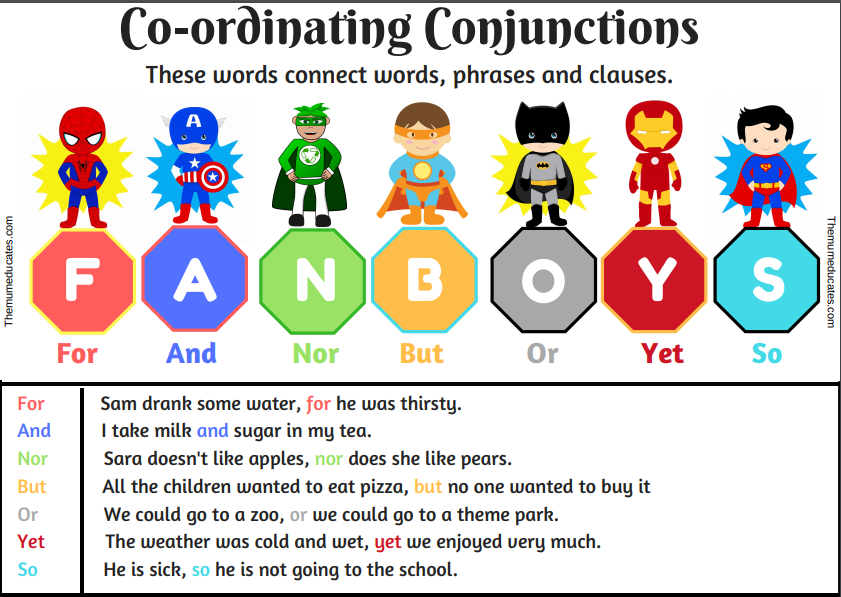
FANBOYS is an acronym for the coordinating conjunctions: for, and, nor, but, or, yet and so!

Arrow Pointing GIF - Arrow Pointing RightHere - Descubre & Comparte GIFs
Coordinating Conjunctions Made Simple with FANBOYS!                                                                                                     

                                                                         
♍ Mnemonic techniques are a blessing. The use of acronyms is a cool and easy way to learn and remember, specially with kids!

SENTENCE PATTERNS👀

 For this topic I made this!


This topic is extremely confusing to me, to master this you really need a lot of practice, reading and patience! 

FRAGMENTS AND RUN-ONS🧩🏃‍♀️

A complete sentence has three components:

  1. A subject (the actor in the sentence)
  2. A predicate (the verb or action)
  3. A complete thought (it can stand alone and make sense—it’s independent

FRAGMENTS🧩

A fragment is an incomplete sentence because is missing one of these parts.

Example: 

Began 30 minutes ago(What began?
We've got a predicate but no subject, this is a fragment.

THE MOVIE BEGAN 30 MINUTES AGO.
That is a sentence!


How do you find and fix your fragments? Remember the basics: subject, verb, and complete thought. If you can recognize those things, you’re halfway there. Then, scan your sentences for subordinating conjunctions. If you find one, first identify the whole chunk of the dependent clause (the subject and verb that go with the subordinator), and then make sure they’re attached to an independent clause.

RUN-ONS🏃

A run-on sentence is when you write two complete sentences but they are connected improperly (without using a coordinating conjunction or proper punctuation).

Example:
 I love to write papers I would write one every day if I had the time.

How to fix them?

Use a period: 
I love to write papers. I would write one every day if I had the time.
Use a semicolon
 I love to write papers; I would write one every day if I had the time.
Use a subordinating conjunction
Because I love to write papers, I would write one every day if I had the time.

Fragments and run-ons seem like beginner problems, but they happen more often than you think! Always check what you write, look for this kind of mistakes.
I know for a fact that I will screw texts up with these. 😗✌